
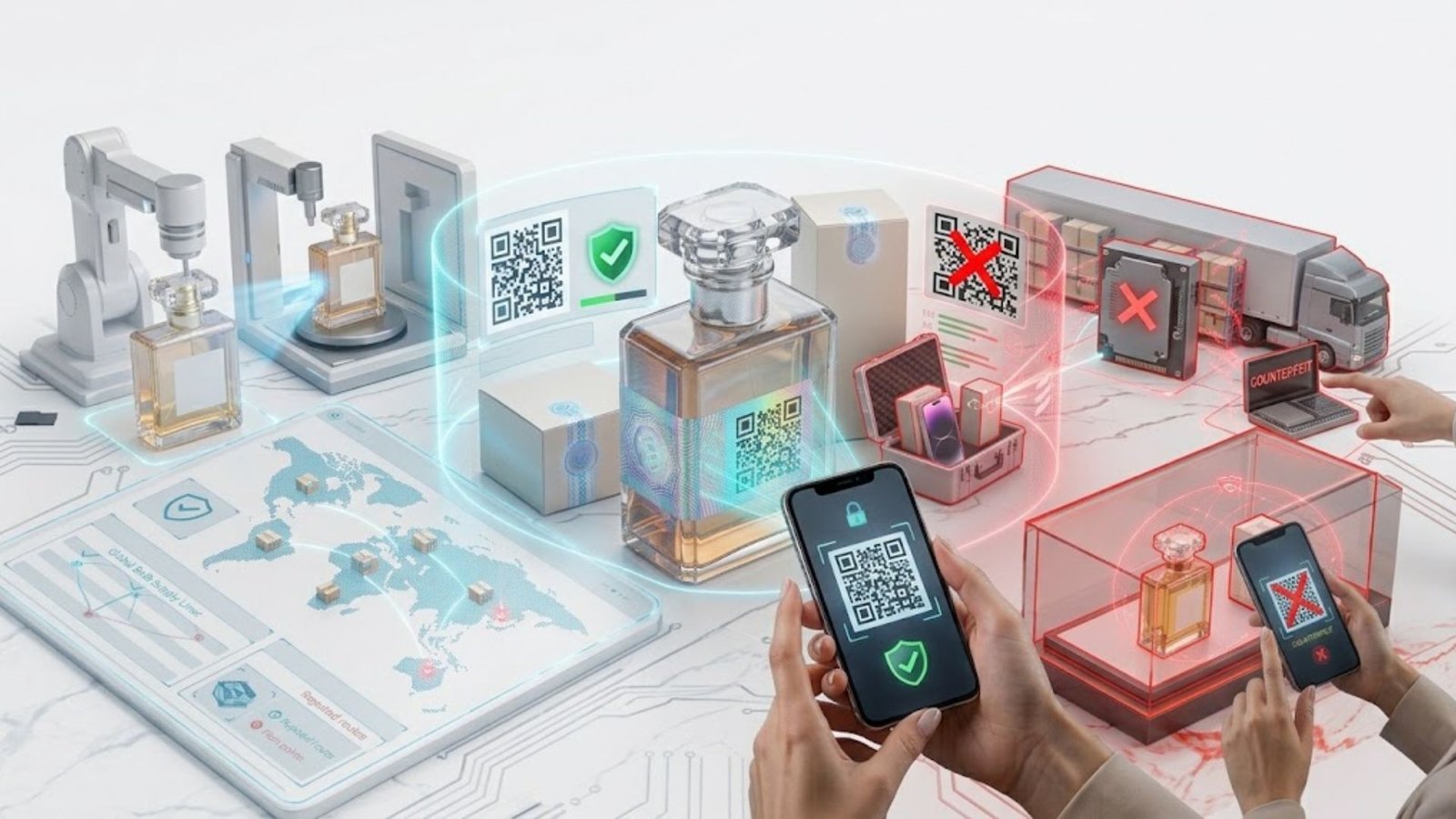
A counterfeit product does not always look counterfeit.
Modern copying techniques can reproduce packaging, labels, logos, serial numbers, and even familiar security features closely enough to make visual inspection unreliable. For a brand owner, that creates a difficult problem: the product may look legitimate, while the question of whether it actually came from the manufacturer remains unanswered.
That is the problem anti-counterfeiting technology is designed to solve.
Depending on the product and the risk involved, a company might use a hologram, security ink, RFID tag, serialized QR code, tamper-evident seal, invisible marking, or a technology that authenticates the physical product itself. Some solutions are obvious to the person checking the product. Others are deliberately hidden.
The important part is choosing the right type of protection.
A security feature that works well on a folding carton may not make sense for a molded plastic component. Likewise, a QR code can provide useful product identification and traceability, but simply printing a QR code does not automatically prove that the physical product carrying it is genuine.
This guide looks at how modern anti-counterfeit solutions work, where different technologies fit, and how businesses can build a product authentication strategy without unnecessarily changing their existing production processes.
What Is Anti-Counterfeiting Technology?

Anti-counterfeiting technology covers the methods used to make counterfeit products harder to produce, easier to identify, or easier to distinguish from genuine products.
Some technologies protect the packaging. Others protect the product itself. Some are designed mainly for supply-chain visibility, while others are specifically intended to answer one question:
Is this item authentic?
That distinction matters.
A serialized identifier can tell a company which product number it is looking at. A track-and-trace platform can provide information about where that identifier has been scanned. But neither necessarily proves that a counterfeiter has not copied the identifier onto a fake product.
Authentication adds another layer.
Modern anti-counterfeiting solutions can include:
- Invisible digital security features
- Product fingerprinting
- Secured QR codes
- RFID and NFC
- Holograms
- Security inks
- Tamper-evident features
- Serialization
- Digital watermarking
- Microprinting
- Optical authentication
- Track-and-trace systems
- Smartphone-based product authentication
The best approach depends on the product, manufacturing environment, threat model, and people who need to verify authenticity.
Why Counterfeit Protection Has Become More Complicated
Counterfeiting used to be associated mainly with obviously inferior copies. That is no longer a reliable assumption.
A counterfeit package can reproduce a brand’s colors and artwork. A copied QR code can lead to a legitimate website. A fake label can carry a real serial number. A visually convincing product can pass a basic inspection even though it did not come from the original manufacturer.
That creates several problems for legitimate brands.
Lost Revenue
Counterfeit products compete with genuine products, often without carrying the same manufacturing, quality-control, regulatory, or development costs.
Brand Reputation
Customers do not always know they have purchased a counterfeit. If the product performs poorly, the brand may receive the blame.
Product Safety
For pharmaceuticals, medical products, food, beverages, automotive components, and other safety-sensitive goods, counterfeit products can create risks that go beyond financial losses.
Supply Chain Problems
Counterfeit goods can enter distribution channels, marketplaces, or secondary markets. Identifying them after they have moved through several stages of distribution can be difficult.
Consumer Trust
Brands increasingly need practical ways to help consumers, distributors, investigators, and other stakeholders distinguish authentic products from copies.
That is why brand protection and product authentication increasingly overlap with supply-chain security.
Authentication and Traceability Are Not the Same Thing
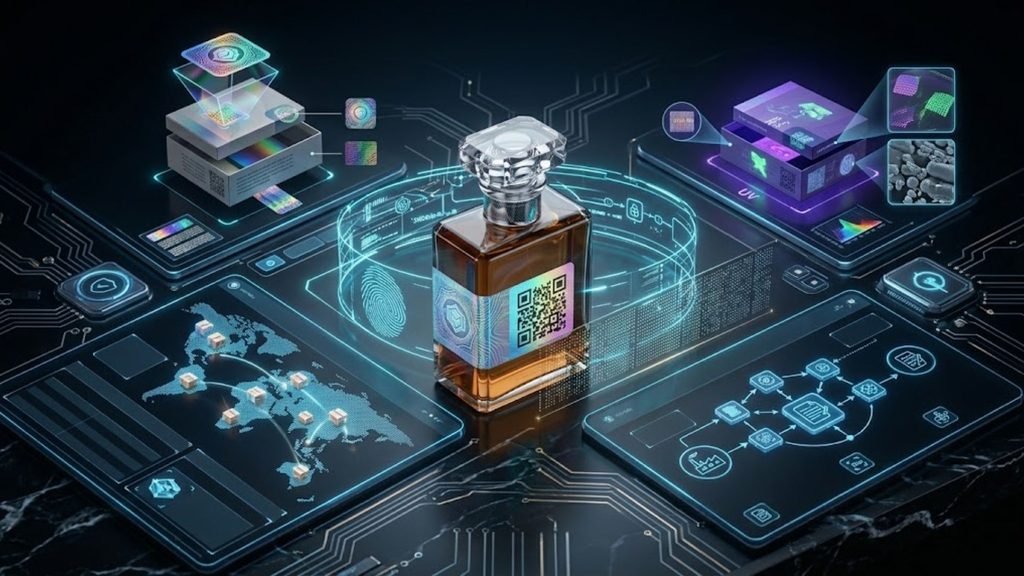
This is one of the most important concepts when evaluating anti-counterfeiting technology.
Imagine a product with a QR code containing a serial number.
A customer scans it and sees information confirming that the number belongs to a genuine product. That is useful—but what if a counterfeiter has copied the same QR code onto another package?
The copied package can now point to the same legitimate information.
This is where authentication becomes important.
Traceability is concerned with the identity and movement of a product. Authentication is concerned with determining whether the security feature or physical product is genuine.
The two can work together.
For example, a business may use serialization for product identification and supply-chain tracking while adding a covert authentication feature to help identify copied products.
AlpVision’s Secured QR Code is designed around this concept by adding an invisible security layer to a standard QR code so that the code can retain its normal appearance while gaining an authentication function.
How Does Anti-Counterfeiting Technology Work?
There is no single authentication mechanism used across every anti-counterfeit system.
Some technologies add a special material to the product. Others modify the printed surface. Some use electronic tags. Others analyze microscopic characteristics that already exist on the product.
In general, the process looks something like this:
A security characteristic is created or identified → the product is associated with an authentication record → the feature is inspected → the system determines whether the product or feature matches what is expected.
The inspection method depends on the technology.
It might involve:
- A smartphone camera
- A dedicated mobile application
- An optical reader
- RFID or NFC hardware
- A specialized scanner
- A laboratory or forensic system
For large-scale consumer products, ease of authentication can be just as important as the security feature itself. A highly sophisticated system may not be practical if the intended user cannot operate it easily.
The Main Types of Anti-Counterfeiting Technology
There is no universal solution. Each category solves a somewhat different problem.
QR Codes and Secured QR Codes
QR codes are already familiar to consumers and are inexpensive to print. They can be used for product information, marketing, serialization, and track and trace.
The limitation is straightforward: a normal QR code is visible and can be copied.
That does not make QR codes useless. It means that identification and authentication should not automatically be treated as the same thing.
A secured QR code takes the familiar QR format and adds a covert security element.
AlpVision’s Secured QR Code uses microscopic modifications that remain invisible to the naked eye. The company says the security layer can be detected with a dedicated smartphone application while the QR code remains readable as a conventional code.
This approach can be particularly relevant for products that already have QR codes printed on labels, cartons, or packaging.
Invisible Digital Markings
An invisible marking is exactly what it sounds like: a security feature that is not apparent during ordinary visual inspection.
This can be useful for brands that do not want their packaging design to change.
It also has another advantage.
If the authentication feature is not obvious, a counterfeiter may not immediately know what needs to be reproduced.
AlpVision Cryptoglyph is one example. AlpVision describes it as an invisible digital authentication technology for printed products, using microscopic features introduced into the printed surface. It can be applied using existing printing processes and does not require special inks or consumables.
That makes this type of technology particularly interesting for printed packaging, labels, cartons, documents, and similar products.
Product Fingerprinting
Product fingerprinting takes a different approach.
Instead of putting a new visible security feature on an object, the authentication system can use microscopic characteristics of the object itself.
Manufacturing processes can leave tiny surface irregularities on molded or manufactured products. Those characteristics may be difficult to reproduce precisely.
AlpVision Fingerprint uses this concept to authenticate physical products without adding a conventional visible security marking. AlpVision lists applications including molded products, mechanical parts, electrical appliances, precious metals, watches, and other physical goods.
This distinction is useful:
Cryptoglyph protects the printed surface.
AlpVision Fingerprint protects the physical product by using its microscopic surface characteristics.
The choice therefore depends partly on what the brand actually needs to protect.
RFID and NFC
RFID and NFC use electronic communication rather than purely printed security features.
RFID can be useful for inventory management, supply-chain operations, product identification, and certain authentication applications. NFC can also allow a compatible smartphone or reader to interact with an embedded tag.
These technologies can be powerful, but implementation usually involves additional components and supply-chain considerations.
A business needs to consider the cost of tags, readers, manufacturing integration, durability, and the environment in which authentication will take place.
For some products that investment makes sense. For others, a covert printed or product-based solution may be simpler.
Holograms
Holograms have been used as visible security features for decades.
They are easy for consumers to recognize and can make packaging look more difficult to reproduce.
The downside is that the feature is visible.
Once a security element becomes widely known, counterfeiters can study it and attempt to reproduce its appearance.
That does not make holograms ineffective. It simply explains why brands often combine visible security features with hidden authentication mechanisms rather than relying on appearance alone.
Security Inks
Security inks can contain characteristics that are not visible under ordinary conditions but can be detected using particular light sources or readers.
Depending on the formulation and application, these features can be used on:
- Packaging
- Labels
- Documents
- Certificates
- Security printing
They can provide another layer of protection, although the required materials and detection equipment should be considered during technology selection.
Tamper-Evident Packaging
Tamper-evident technology addresses a slightly different problem.
A tamper-evident seal or package can indicate that someone has opened, damaged, or interfered with the packaging.
That is useful—but it does not automatically prove that the product is authentic.
For example, an unopened counterfeit package may still look perfectly intact.
This is why tamper evidence and product authentication can complement each other.
Serialization
Serialization gives individual products or packages a unique identity.
It can help businesses manage inventory, recalls, distribution, and supply-chain visibility.
But there is a common misconception:
A unique serial number is not necessarily a secure authentication feature.
If the identifier is visible and can be copied, the counterfeit product can potentially carry the same identifier.
Serialization becomes more useful for counterfeit protection when it is combined with an authentication mechanism that is difficult to copy.
AlpVision’s Approach to Anti-Counterfeiting
AlpVision focuses heavily on covert product authentication—security features that are difficult to see, study, and reproduce.
Its solutions address different parts of the product ecosystem rather than trying to force one technology onto every application.
Cryptoglyph for Printed Products
Cryptoglyph is designed for printed products.
Instead of changing the visual appearance of a package or adding a conventional security label, it introduces microscopic, pseudo-random features into the printed surface.
According to AlpVision, Cryptoglyph can be applied by existing print suppliers using standard inks and printing processes, while authentication is performed with a smartphone and dedicated application.
That makes it relevant to products such as:
- Folding cartons
- Labels
- Documents
- Cans
- Blister packs
- Printed packaging
- Other printed materials
For a company already working with multiple printing suppliers, the ability to fit the security feature into an established printing workflow can be an important consideration.
AlpVision Fingerprint for Physical Products
A printed label is not always the right place to put security.
Sometimes the physical product itself needs protection.
AlpVision Fingerprint uses microscopic surface characteristics already present on a product rather than adding a conventional security marking. AlpVision says the approach can be used on products including molded bottles and caps, electrical appliances, mechanical parts, precious metals, watches, and other molded products.
This can be particularly interesting for manufacturers that want to protect the object itself while maintaining their existing production process.
The basic idea is quite different from a hologram or security sticker:
the product’s own microscopic surface becomes part of the authentication system.
Secured QR Code for QR-Based Systems
For companies that already use QR codes, replacing the entire system may not be necessary.
AlpVision’s Secured QR Code adds a covert security layer to an existing QR code. According to AlpVision, microscopic holes are introduced into the black areas of the code during the printing process, while the visible design remains unchanged. Authentication is performed through a dedicated smartphone application.
The technology is intended to work alongside QR-based identification and track-and-trace systems.
That distinction is important for brands that already have QR infrastructure in place but want additional protection against copied codes.
How Do You Choose the Right Anti-Counterfeit Solution?
Start with the product—not the technology.
Before comparing vendors or security features, answer a few practical questions.
What exactly needs protection?
Is the risk centered around the packaging, the label, the product, or all three?
A printed carton and a molded component present very different authentication challenges.
Who will authenticate the product?
The user might be:
- A consumer
- A distributor
- A retailer
- An internal brand-protection team
- Customs officials
- Law enforcement
- A field inspector
A consumer-facing solution usually needs to be simple. An internal investigation system can tolerate more specialized equipment.
Do you already have serialization?
If the company already uses QR codes, barcodes, or another serialization system, it may be possible to add authentication without rebuilding the entire identification infrastructure.
Can production processes change?
This question is often overlooked.
Changing packaging materials, adding special inks, installing new hardware, or modifying a production line can be expensive at scale.
A technology that works well in a laboratory may be much less attractive if implementing it across multiple factories and print suppliers becomes complicated.
What is the cost per item?
For products manufactured in very large quantities, even a small per-unit cost can become significant.
The total cost should therefore include not only the security feature but also:
- Implementation
- Software
- Readers or mobile applications
- Integration
- Training
- Maintenance
- Data management
How difficult is it to copy?
A security feature should be evaluated based on how difficult it is to duplicate and how difficult it is to forge convincingly.
Those are not always the same problem.
Covert vs. Overt Security Features
Visible and invisible security features each have a role.
Overt features are designed to be seen. Holograms, visible security labels, color-shifting effects, and other recognizable elements can help with visual inspection and consumer awareness.
Covert features are hidden. They are intended for authentication without revealing the protection mechanism to everyone handling the product.
Neither category automatically replaces the other.
A brand might use a visible security feature to give consumers an immediate indication of authenticity while keeping a covert authentication mechanism available for deeper verification.
This layered approach can also make it harder for counterfeiters to understand the complete protection system.
Why Layered Anti-Counterfeiting Protection Matters
Counterfeiters do not necessarily attack a product in only one way.
They may copy packaging, reproduce labels, duplicate QR codes, replace products inside genuine-looking packaging, or manufacture an imitation from scratch.
A single security feature may therefore address only one part of the problem.
A layered strategy might combine:
Serialization + visible security + covert authentication + track and trace
For example, the serialization system can identify an individual item, while a covert feature determines whether the security element or physical product is genuine.
AlpVision’s own technology-selection material separates its solutions according to what is being protected: Cryptoglyph and Secured QR Code are aimed at printed products, while AlpVision Fingerprint is designed to protect the product itself.
That product-specific approach is worth considering when designing a larger brand-protection program.
Anti-Counterfeiting Technology by Industry
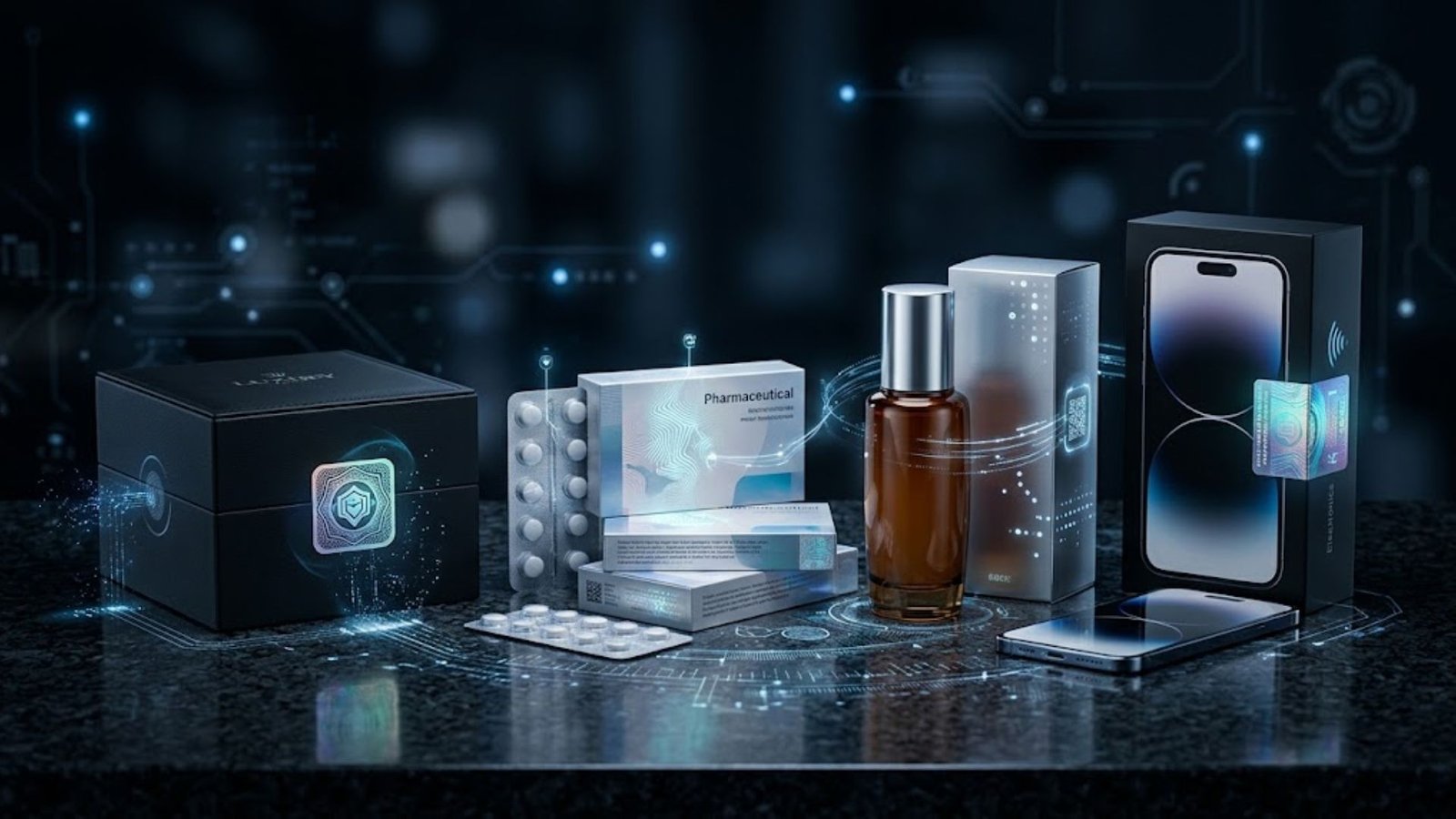
Pharmaceuticals
Pharmaceutical products are a particularly important application for authentication and traceability.
Packaging can be protected with covert printed security features, while serialized identifiers can support supply-chain systems.
AlpVision lists pharmaceutical products among the industries where its authentication technologies are used, including packaging and QR-based applications.
Luxury Goods
Luxury brands need to protect both the product and the customer experience.
Adding a large visible security label may not fit the design of a premium product. Covert authentication can provide another option.
Potential applications include:
- Watches
- Accessories
- Premium packaging
- Certificates
- Labels
- Other high-value products
Food and Beverage
Food, beverage, and alcohol brands can face counterfeit products, unauthorized distribution, and packaging duplication.
Authentication technology can be applied to packaging or, depending on the product, to the physical item itself.
Tobacco Products
Packaging is a major part of product identification in tobacco markets.
AlpVision describes Cryptoglyph and Secured QR Code applications for tobacco-related packaging, while Fingerprint can be used on certain physical products and packaging components.
Electronics and Industrial Products
Counterfeit components can be difficult to identify once they enter complex distribution networks.
Product authentication can help manufacturers protect components, replacement parts, packaging, and finished products.
For physical products, an authentication method based on the product itself can be worth considering where labels or tags are impractical.
Automotive Products
Counterfeit automotive components can create both commercial and safety concerns.
Depending on the component, manufacturers may protect the packaging, label, or physical part.
The important consideration is whether the authentication feature needs to stay with the package or remain with the actual component.
Where Smartphone Authentication Fits
One reason smartphone-based authentication has attracted attention is simple: the device is already in people’s hands.
A company does not necessarily need to distribute a proprietary scanner to every person who might need to verify a product.
With the right technology, a smartphone camera can become the detection device.
AlpVision’s Cryptoglyph, Fingerprint, and Secured QR Code technologies are designed around smartphone-based authentication. Its Secured QR Code application, for example, is designed for iOS and Android and can authenticate the secured feature separately from ordinary QR-code reading.
For large-scale programs, however, the user experience still matters.
Authentication should be fast enough for the intended environment, and the system should make the result understandable to the person performing the check.
Anti-Counterfeiting Technology and Track & Trace
Track and trace systems provide valuable information about products as they move through a supply chain.
They can support questions such as:
- Where was a product produced?
- Which batch does it belong to?
- Where has it been scanned?
- When was it distributed?
- Has the product appeared somewhere unexpected?
But a track-and-trace system is only as trustworthy as the connection between the digital identity and the physical product.
If a visible identifier can be copied, a counterfeit product may inherit the identity of a genuine one.
This is why adding a covert authentication layer can strengthen the relationship between the physical product and its digital record.
AlpVision’s track-and-trace protection offering specifically positions Secured QR Code as a way to combine serialization with counterfeit protection.
What Should Brands Look for in Anti-Counterfeiting Technology?
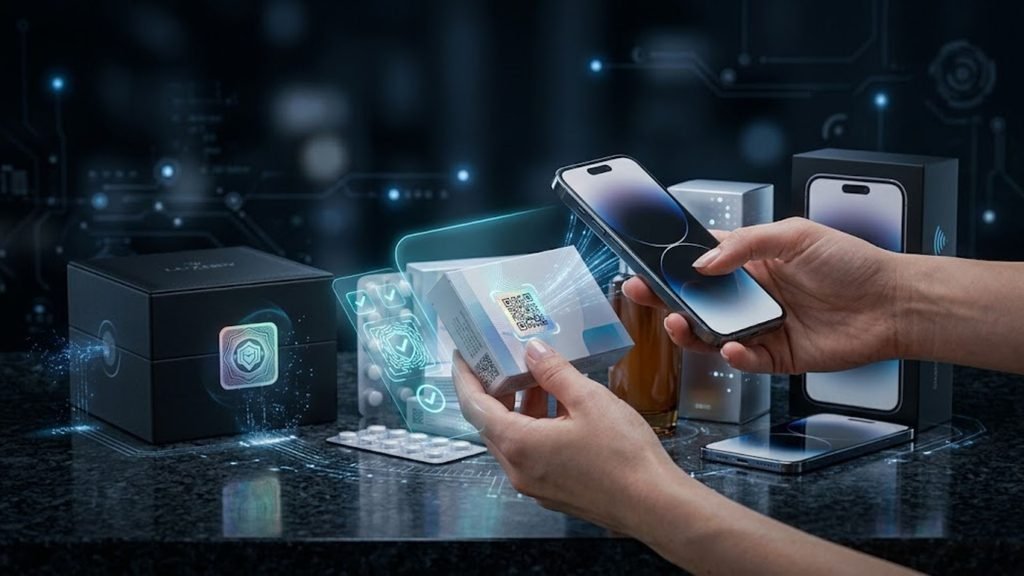
There is no universal checklist that produces the same answer for every company, but several factors deserve attention.
Security: How difficult is the feature to duplicate or forge?
Deployment: Can it be introduced without disrupting production?
Scalability: Can it work across the company’s expected production volume?
Authentication: How is authenticity actually determined?
User experience: Can the intended users authenticate products without unnecessary complexity?
Integration: Can the technology work alongside existing serialization, packaging, and track-and-trace systems?
Cost: What will the solution cost to deploy and operate at the required scale?
Visibility: Should the security feature be visible, hidden, or both?
A solution that looks impressive in a demonstration is not necessarily the right solution for a production environment.
The practical question is whether the technology can work reliably across the company’s real products, factories, suppliers, and markets.
The Future of Product Authentication
The direction of product authentication is increasingly moving toward a combination of physical and digital security.
QR codes and digital identifiers are becoming common because they are convenient. At the same time, brands still need a way to establish that the physical object connected to a digital record is authentic.
That is creating more interest in covert authentication, smartphone verification, product fingerprinting, and layered security.
Another development is the growing connection between product identity and digital product information.
A digital record can tell a customer or supply-chain partner a great deal about a product. But the record itself does not necessarily prove that the physical object in front of them is genuine.
The physical-to-digital connection therefore needs protection as well.
For brands, the future is less about choosing between “physical security” and “digital security” and more about deciding how those two layers should work together.
Frequently Asked Questions
What is anti-counterfeiting technology?
Anti-counterfeiting technology includes security features and systems designed to prevent, detect, or authenticate counterfeit products. These can include QR-based authentication, RFID, holograms, security inks, serialization, invisible markings, product fingerprinting, and track-and-trace systems.
Is a QR code enough to prevent counterfeiting?
Not necessarily. A standard QR code can be copied. It can still be useful for product identification and traceability, but authentication may require an additional security layer.
What is the difference between a QR code and a Secured QR Code?
A standard QR code stores readable information. A Secured QR Code adds a covert authentication feature designed to help detect copying while maintaining the normal visual appearance of the QR code.
What is Cryptoglyph?
Cryptoglyph is AlpVision’s invisible digital product authentication technology for printed products. It introduces microscopic features into the printed surface and can be authenticated using a smartphone and dedicated application.
What is AlpVision Fingerprint?
AlpVision Fingerprint authenticates physical products using microscopic surface characteristics of the product itself. It is intended for physical products where protecting the object, rather than only its packaging, is important.
Can anti-counterfeiting technology be added without changing packaging design?
Some technologies are specifically designed to operate without visible changes to the product or packaging. Cryptoglyph and Secured QR Code are examples of AlpVision solutions designed around invisible security.
Can consumers authenticate products using a smartphone?
Yes. Some authentication technologies are designed for smartphone-based verification, although the exact authentication process depends on the technology.
Is serialization the same as authentication?
No. Serialization identifies an individual product or package. Authentication determines whether the product or security feature is genuine. The two can be combined in a broader product protection strategy.
Should a company use more than one anti-counterfeiting technology?
It can make sense to use multiple layers when different technologies address different risks. For example, serialization can provide product identity while a covert feature provides authentication.
How should a company choose an anti-counterfeiting solution?
Start with the product and the business problem. Consider what needs protection, who will authenticate it, how the product is manufactured, whether existing QR or serialization systems are already in place, the required production volume, and how much change the company can make to its current process.
Protecting a Product Starts With the Right Authentication Strategy
Counterfeit protection is not simply a matter of putting a security feature on a package and calling the product protected.
The real question is whether the security feature fits the product, survives the manufacturing process, can be authenticated by the intended users, and provides meaningful protection against the way counterfeiters are actually attacking the brand.
For printed packaging and labels, an invisible authentication technology such as AlpVision Cryptoglyph can provide a covert layer without changing the visible appearance of the design.
For physical products, AlpVision Fingerprint takes a different approach by using microscopic characteristics of the product itself.
And where a company already relies on QR codes for product identification or track and trace, Secured QR Code can add an invisible authentication layer to the existing code.
The right choice ultimately depends on the product and the problem being solved.
For companies evaluating anti-counterfeiting technology, the strongest starting point is not simply asking, “Which security feature should we buy?”
It is asking:
“What needs to be authenticated, who needs to authenticate it, and how can we add that protection without creating unnecessary complexity in our existing operation?”
That question leads to a much more practical product authentication strategy—and ultimately to better protection for the brand, the supply chain, and the people who rely on genuine products.