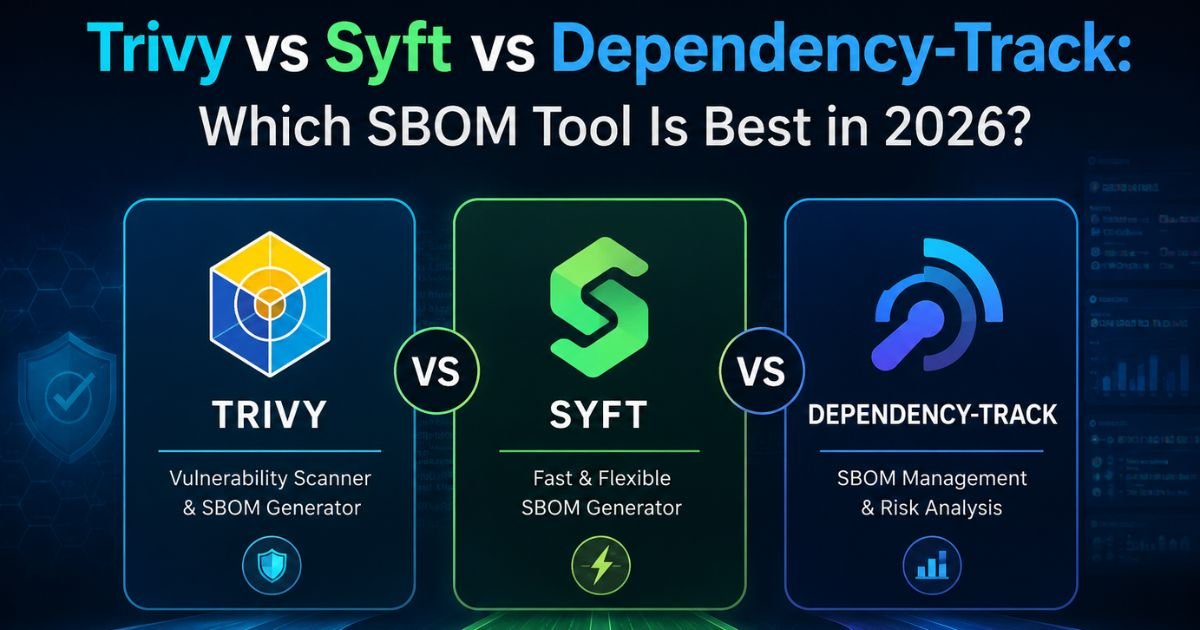
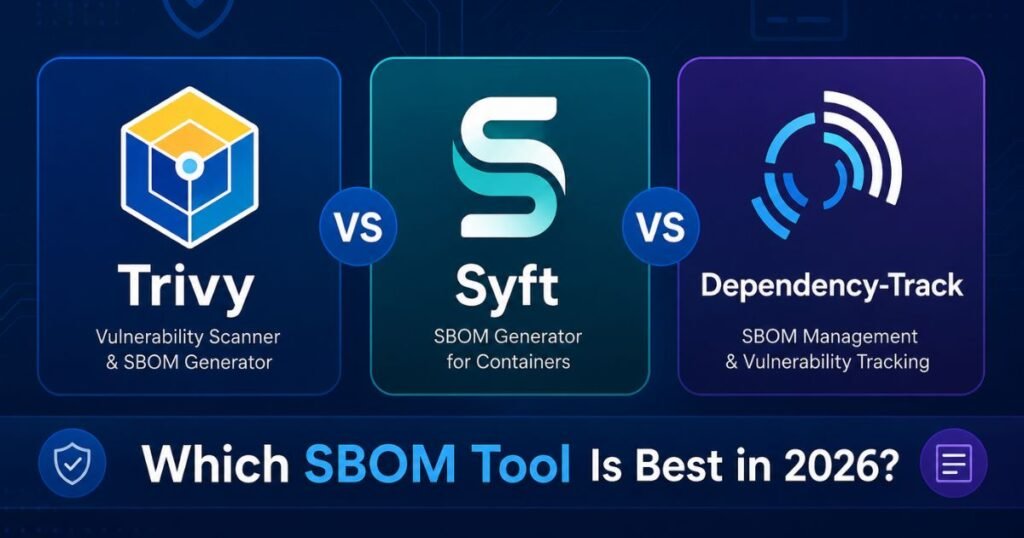
Choosing the right SBOM tool can shape how well your team finds, tracks, and manages software risk. In 2026, the debate around Trivy vs Syft vs Dependency-Track matters because each platform solves a different problem. Syft focuses on detailed SBOM generation, Trivy combines inventory with CVE scanning, and Dependency-Track supports ongoing SBOM management across many products.
The best option depends on your pipeline, compliance needs, and security maturity. This guide compares accuracy, formats, VEX support, integrations, and operational effort. By the end, you’ll understand which tool fits each stage and how to build a stronger software supply-chain security workflow without adding needless complexity for modern development and enterprise security teams.
Trivy vs Syft vs Dependency-Track: The Short Answer
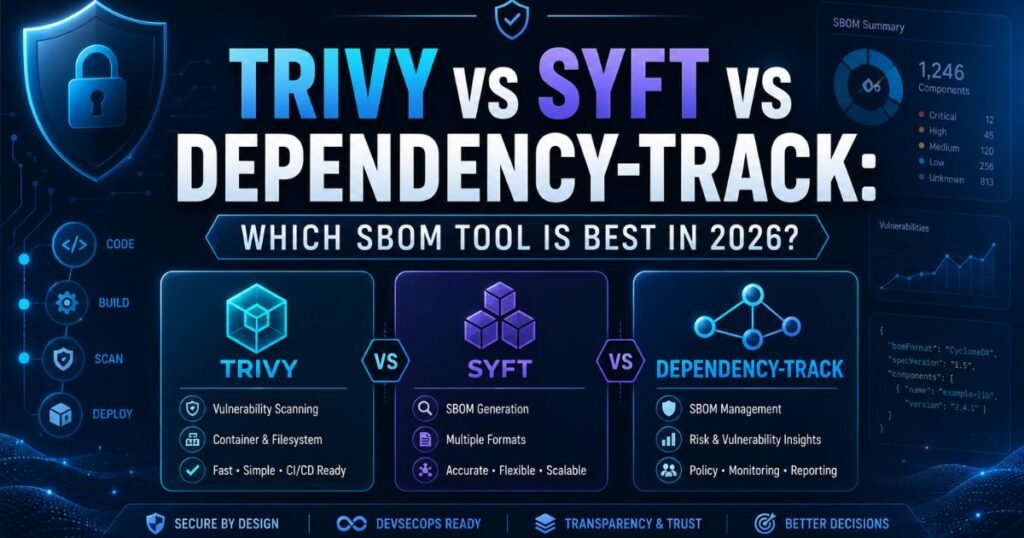
Choose Syft when detailed inventory creation is your main goal. Choose Trivy when you need one CLI for inventory and scanning. Choose Dependency-Track when your organization needs centralized SBOM management, historical analysis, policies, and portfolio-wide risk visibility.
For many teams, the best answer isn’t one product. A practical Syft Trivy Dependency-Track stack generates accurate inventory, scans releases before deployment, and monitors published components afterward. Each tool handles a different stage instead of duplicating the entire workflow.
When to choose Syft
The answer to when to choose Syft starts with specialization. Anchore Syft focuses on package discovery and SBOM output. It scans container images, directories, files, and archives while using dedicated catalogers for many languages, operating systems, and binary types.
When to choose Trivy
The answer to when to choose Trivy is broader. Trivy generates CycloneDX or SPDX inventories and scans images, filesystems, repositories, Kubernetes targets, and existing SBOMs. It suits teams already using Aqua Security tooling or wanting one streamlined pipeline command.
When to choose Dependency-Track
The answer to when to choose Dependency-Track centers on scale. OWASP Dependency-Track ingests CycloneDX documents and tracks components across every version of every project. It continuously evaluates security, license, integrity, and policy risks.
Which is better Syft or Trivy?
The question which is better Syft or Trivy depends on your task. Syft is usually the clearer dedicated generator. Trivy offers the cleaner all-in-one experience when you also need CVE scanning, license checks, repository analysis, or container security controls.
Trivy vs Dependency-Track
A Trivy vs Dependency-Track comparison isn’t truly head-to-head. Trivy usually operates during development and release pipelines. Dependency-Track remains active after upload, preserving project history and reassessing components when new vulnerability information appears.
Syft vs Dependency-Track
Likewise, Syft vs Dependency-Track compares a generator with an SBOM analysis platform. Syft creates the component record. Dependency-Track consumes that record and turns it into an ongoing security, governance, and reporting process.
What an SBOM Actually Is and Why It Matters
A Software Bill of Materials is a machine-readable inventory of software components and their relationships. CISA describes an SBOM as a key building block for software security and supply-chain risk management. NIST highlights transparency, provenance, and faster vulnerability response.
However, an SBOM doesn’t prove that software is safe. It shows what may be present. Teams still need vulnerability management, exploitability analysis, remediation ownership, secure builds, testing, configuration controls, and incident response.
What is an SBOM?
The question what is an SBOM is easiest to answer through an ingredients-label analogy. It records packages, versions, suppliers, relationships, identifiers, and other metadata. This component inventory gives producers and customers clearer visibility into software composition.
What information does an SBOM contain?
The answer to what information does an SBOM contain varies by standard and tool. Useful records may include names, versions, Package URLs, CPEs, hashes, suppliers, licenses, dependency paths, creation details, and the primary application or artifact.
What are direct and transitive dependencies?
The question what are direct and transitive dependencies matters because manifests rarely tell the whole story. Direct dependencies are intentionally added by developers. Transitive dependencies enter through those packages, often several levels deep.
SBOM generation, scanning, and management
These three stages shouldn’t be confused. Generation discovers software. Dependency scanning matches identified components with known security records. Management retains product versions, decisions, policies, and trends. A mature program connects all three stages.
| Stage | Primary question | Typical tool |
|---|---|---|
| SBOM generation | What components exist inside this artifact? | Syft or Trivy |
| software composition analysis | Which components may carry known risks? | Trivy, Grype, or commercial SCA tools |
| SBOM aggregation | Which products use each component? | Dependency-Track |
| portfolio analysis | Where does one vulnerability affect the organization? | Dependency-Track |
| compliance reporting | Can we demonstrate inventory, policies, and decisions? | Dependency-Track or a commercial platform |
CycloneDX vs SPDX
The CycloneDX vs SPDX decision should follow consumer needs. CycloneDX offers deep supply-chain and vulnerability capabilities, including native VEX models. SPDX is an ISO-recognized standard with profiles covering software, licensing, security, build, data, and AI information.
Which SBOM format should I use?
For which SBOM format should I use, choose CycloneDX for security workflows when your downstream platform expects CycloneDX-native vulnerability or VEX data. Choose SPDX for license compliance when contracts, legal review, or downstream consumers require SPDX’s licensing model.
Why U.S. organizations care
U.S. federal software-security efforts accelerated through US Executive Order 14028 and related NIST and CISA guidance. The order strengthened expectations for software transparency, secure development, and vulnerability response within federal procurement and supply chains.
Trivy vs Syft vs Dependency-Track Comparison Matrix
This Trivy vs Syft vs Dependency-Track comparison shows why a single ranking can mislead. The tools address related problems but operate at different layers. The best result comes from matching each capability with your actual engineering and governance needs.
When asking which SBOM tool is best in 2026, compare component detection, format fidelity, vulnerability matching, VEX, integrations, maintenance, policy controls, and ownership. Don’t choose based only on the number of findings displayed.
| Capability | Syft | Trivy | Dependency-Track |
|---|---|---|---|
| Primary function | Dedicated generator | Generator and security scanner | Persistent analysis and governance platform |
| Typical stage | Build or release | Commit, build, release, or deployment | Post-build and continuous operations |
| container image scanning | Inventories container contents | Inventories and scans containers | Analyzes uploaded inventories |
| filesystem scanning | Yes | Yes | Not a direct scanning target |
| Git repository scanning | Source and directory cataloging | Repository scanning supported | Receives generated BOMs |
| Kubernetes security | Inventory-focused use | Kubernetes and KBOM scanning | Portfolio and policy analysis |
| CycloneDX JSON | Output supported | Output and input supported | Native ingestion and production |
| SPDX JSON | Output supported | Output and input supported | Not its native ingestion standard |
| Native VEX management | Limited generator role | Can consume supported VEX information | Strong CycloneDX VEX workflow |
| Vulnerability matching | Pair with Grype or another scanner | Built in | Continuous correlation |
| license metadata | Included where detected | Scanning and classification available | License analysis and policies |
| policy engine | No central engine | Pipeline and Rego-based controls | Expression and vulnerability policies |
| Historical projects | No | No central portfolio by default | Yes |
| continuous monitoring | No | Requires scheduled rescanning | Core platform capability |
| Operational model | CLI or container | CLI, container, or server workflow | Persistent multi-user platform |
Syft supports CycloneDX, SPDX, and native Syft JSON outputs. Trivy generates standard SBOMs and scans supported CycloneDX and SPDX inputs. Dependency-Track is CycloneDX-native and focuses on persistent component intelligence.
Best open-source SBOM generator
There isn’t a universal best open-source SBOM generator for every stack. Syft often fits teams prioritizing detailed cataloging. Trivy may win when operational simplicity matters more than using a specialized generator.
Best SBOM management platform
Among these three products, Dependency-Track is the clear best SBOM management platform candidate because centralized management is its core purpose. However, organizations should test scalability, identity integration, database operations, and reporting requirements before standardization.
Best SBOM tools for DevSecOps
The best SBOM tools for DevSecOps support automation without creating an abandoned compliance artifact. Your selected tools should integrate with builds, preserve artifact identity, apply policies, trigger remediation, and support later investigations.
SBOM Generation Accuracy, Coverage, and Format Support
Accuracy involves more than finding the largest number of packages. Good SBOM package detection accuracy means correct names, versions, ecosystems, identifiers, licenses, relationships, and evidence. Duplicate or wrongly matched packages can make a larger SBOM less useful.
Any credible SBOM generation accuracy comparison must test real workloads. Java archives, Python environments, Go binaries, npm applications, Linux packages, and containers expose different blind spots across package ecosystems and package managers.
How Syft generates SBOMs
Understanding how Syft generates SBOMs starts with catalogers. Syft uses specialized modules for declared packages, installed packages, operating-system packages, language files, archives, and binaries. This modular model supports broad discovery and configurable scanning.
Syft package ecosystem coverage
Strong Syft package ecosystem coverage comes from dozens of catalogers spanning Python, Java, Go, JavaScript, Ruby, Rust, DEB, RPM, APK, and other formats. However, real accuracy still depends on scan target, package evidence, and configuration.
Richest SBOM metadata
The phrase richest SBOM metadata shouldn’t become an unsupported marketing verdict. Syft’s native JSON can preserve tool-specific evidence that standardized outputs may not represent fully. Teams should compare required fields rather than file size alone.
How Trivy generates SBOMs
The answer to how Trivy generates SBOMs involves applying its package-detection logic to images, filesystems, repositories, or root filesystems. Trivy can then produce standard output while optionally running security scanners through related commands.
Trivy SBOM generation and vulnerability scanning
The value of Trivy SBOM generation and vulnerability scanning lies in consolidation. One tool can identify packages, create inventory, and evaluate vulnerabilities. However, Trivy warns that scanning third-party SBOMs may lose accuracy when its expected custom properties are absent.
Does Dependency-Track generate SBOMs?
For does Dependency-Track generate SBOMs, the practical answer is generally no at build time. Dependency-Track expects CycloneDX documents produced by pipelines or suppliers. It then ingests, analyzes, stores, and governs those inventories.
Source scan versus final artifact
Source manifests may contain build tools or test packages absent from production. Final images may contain operating-system packages missing from source declarations. Therefore, build artifacts should usually receive their own inventory before release.
How to validate CycloneDX SBOMs
To understand how to validate CycloneDX SBOMs, check schema validity, root component identity, package URLs, versions, hashes, relationships, and required organizational fields. SBOM validation should also compare the document with the actual release artifact.
How to convert SBOM formats
The answer to how to convert SBOM formats requires caution. Syft provides experimental SBOM conversion between supported standards but warns that information may be lost. Conversion should include field-by-field validation before compliance or security use.
Best tool for CycloneDX generation
The best tool for CycloneDX generation depends on your ecosystem. Syft and Trivy both produce CycloneDX. Language-specific CycloneDX tools or CycloneDX CLI utilities may provide deeper standard-specific validation or manipulation in selected workflows.
Best tool for SPDX generation
The best tool for SPDX generation must support the version and fields your consumer expects. Syft and Trivy both generate SPDX, but organizations should test whether relationships, licensing details, hashes, and application metadata survive downstream processing.
Vulnerability Detection, Monitoring, and Risk Prioritization
An SBOM identifies components, while a scanner performs vulnerability correlation. Matching quality depends on Package URLs, CPEs, versions, operating-system context, advisory sources, and vendor fixes. The same inventory can produce different results across vulnerability databases.
Effective risk prioritization requires more than severity. Teams should combine CVSS, exploit probability, exposure, asset value, fix availability, deployment status, and reachability. High numbers without context create alert fatigue rather than safer software.
How CVE correlation works
The question how CVE correlation works begins with identifiers. A scanner maps component coordinates against advisory records from sources such as NVD, GitHub Advisories, OSV, vendor feeds, or OSS Index. Incomplete identifiers can create missed or incorrect matches.
Trivy for CVE scanning
Using Trivy for CVE scanning provides fast feedback across images, filesystems, repositories, Kubernetes environments, and SBOM files. Trivy maintains vulnerability data from operating-system and language-specific sources.
How Dependency-Track analyzes SBOMs
The answer to how Dependency-Track analyzes SBOMs includes component matching, recurring intelligence updates, policy checks, license evaluation, and project impact analysis. The platform supports several internal and external intelligence sources.
Dependency-Track for continuous monitoring
Dependency-Track for continuous monitoring matters after deployment. Newly disclosed vulnerabilities can affect old releases without changing their SBOM. Dependency-Track re-evaluates stored inventories as its vulnerability intelligence changes.
CVSS and EPSS
CVSS estimates technical severity. EPSS estimates the probability of exploitation activity. Dependency-Track integrates EPSS to improve prioritization. Neither score alone replaces environmental context or analyst judgment.
What is VEX in software security?
The question what is VEX in software security refers to Vulnerability Exploitability Exchange. VEX communicates whether a known vulnerability affects a product in its specific context. It may record affected, not affected, fixed, or under-investigation states.
How VEX reduces false positives
Understanding how VEX reduces false positives requires precision. VEX doesn’t erase a CVE. It adds product-specific analysis showing why vulnerable code may be unreachable or absent. This supports false-positive reduction without hiding the original evidence.
How to create VEX attestations
For how to create VEX attestations, organizations need a documented decision, product identity, vulnerability reference, status, justification, evidence, author, and timestamp. VEX attestations should receive technical review and periodic reassessment.
How Dependency-Track manages VEX
The phrase how Dependency-Track manages VEX covers CycloneDX VEX ingestion, production, auditing, and portfolio analysis. Dependency-Track supports VEX alongside vulnerability disclosure reports and permanent finding records.
Best tool for VEX management
Among the three, Dependency-Track offers the strongest case as the best tool for VEX management because it maintains long-lived product context and audit history. Trivy can consume supported VEX information during scanning but isn’t a centralized VEX governance platform.
How to prioritize SBOM vulnerabilities
For how to prioritize SBOM vulnerabilities, combine severity, exploit probability, internet exposure, reachable functionality, asset criticality, compensating controls, and patch availability. This approach makes threat intelligence actionable rather than decorative.
How to reduce SBOM vulnerability noise
The answer to how to reduce SBOM vulnerability noise includes accurate identifiers, vendor-aware matching, deduplication, VEX, supported-version checks, and evidence-based suppression. Avoid blanket exclusions because they conceal genuine risk.
CI/CD Integration, Deployment, and Operational Complexity
CLI-based DevSecOps tools fit pipelines quickly. However, a central platform brings databases, authentication, upgrades, backup, monitoring, and retention obligations. Your tool decision must include ownership and operational cost, not only installation speed.
Strong CI/CD pipeline security connects inventory to the exact artifact being shipped. The workflow should fail safely when critical evidence is missing while allowing documented exceptions through controlled policy enforcement.
How to generate an SBOM in CI/CD
The process for how to generate an SBOM in CI/CD should run after creating the final release artifact. Scan the image, package, or binary that production will use. Assign immutable version and digest information before storing the result.
How to add SBOM generation to a pipeline
For how to add SBOM generation to a pipeline, define the generator version, target, format, naming convention, retention location, validation rules, and failure behavior. Unpinned tools can change output unexpectedly between builds.
Syft for SBOM generation
Using Syft for SBOM generation works well when teams want dedicated inventory output. Syft is distributed as a standalone CLI and supports container images, directories, files, archives, registries, and several standard formats.
How to scan an SBOM for vulnerabilities
For how to scan an SBOM for vulnerabilities, Trivy accepts CycloneDX, SPDX, SPDX JSON, supported attestations, and Kubernetes BOMs. It performs vulnerability scanning by default and can add license scanning.
How to upload SBOMs to Dependency-Track
The answer to how to upload SBOMs to Dependency-Track involves its REST API, CI integrations, or web interface. Projects should use stable names and unique versions so each release remains traceable.
How to manage SBOMs at scale
For how to manage SBOMs at scale, centralize project ownership, version history, access control, retention, policy rules, and alerts. Dependency-Track portfolio management supports project hierarchies, time-series metrics, vulnerability auditing, and cross-project searches.
Dependency-Track policy engine
The Dependency-Track policy engine evaluates component and vulnerability conditions. Version 5 adds expression-based policies and stronger operational scaling. Teams can connect failures to pipeline decisions, notifications, or remediation workflows.
Best tool for policy enforcement
Dependency-Track is the strongest best tool for policy enforcement candidate within this comparison. Trivy can enforce pipeline outcomes and Rego-based ignore policies. Dependency-Track adds centralized rules, project context, audit trails, and portfolio governance.
The 2026 Reference SBOM Workflow
A mature SBOM workflow for 2026 starts during the build but continues throughout the product lifecycle. It links source, artifact, inventory, vulnerability results, signatures, release records, monitoring, and remediation.
The ideal reference SBOM workflow creates supply-chain transparency without generating unmanageable paperwork. Automation should produce evidence. Human review should handle exceptions, exploitability decisions, and risk acceptance.
| Stage | Action | Recommended capability |
|---|---|---|
| 1 | Build the final software artifact | Reproducible build controls |
| 2 | Generate CycloneDX or SPDX inventory | Syft or Trivy |
| 3 | Validate identity and required metadata | Schema and custom validation |
| 4 | Run vulnerability and license checks | Trivy or another scanner |
| 5 | Sign or attest the inventory | Cosign and Sigstore |
| 6 | Store evidence beside the artifact | Registry or immutable evidence store |
| 7 | Upload CycloneDX to Dependency-Track | API-based SBOM ingestion |
| 8 | Apply policies and triage findings | Policy engine and VEX |
| 9 | Monitor newly disclosed vulnerabilities | Continuous analysis |
| 10 | Trigger tickets, rebuilds, and reports | Integrated response workflows |
How to sign an SBOM with Cosign
For how to sign an SBOM with Cosign, generate the inventory and attach it as an attestation to the relevant image. Trivy documents CycloneDX and SPDX attestation workflows using Cosign and Sigstore.
How to store SBOMs as OCI artifacts
The method for how to store SBOMs as OCI artifacts should preserve the relationship between each inventory and its exact image digest. OCI artifacts and registry attestations can keep release evidence close to the software they describe.
Signed SBOMs and software attestations
Signed SBOMs help verify integrity and publisher identity. They don’t prove inventory completeness. Strong software attestations should connect the build, artifact digest, tool version, subject, predicate, and signing identity.
How to verify SBOM signatures
For how to verify SBOM signatures, validate the signer, trust policy, artifact digest, attestation type, and transparency record before using the SBOM. Signature verification without identity policy provides limited assurance.
How to prevent unsigned software deployments
The answer to how to prevent unsigned software deployments involves registry controls and cluster policy. Deployment systems should reject artifacts lacking trusted signatures or required attestations rather than depending on manual review.
Kubernetes admission control for SBOMs
Kubernetes admission control for SBOMs can check evidence before workloads enter a cluster. OPA Gatekeeper, Kyverno, or another Kubernetes admission controller may enforce signature, provenance, image, and policy requirements.
How to enforce SBOM policies
For how to enforce SBOM policies, encode clear, testable requirements through policy-as-code. Examples include mandatory SBOM presence, approved licenses, blocked components, acceptable vulnerability states, and required signatures.
Audit-ready verification
True audit-ready verification means an auditor can connect each deployed artifact to its inventory, scan, exception, approval, and remediation history. A folder full of unrelated JSON files doesn’t meet that operational goal.
Recommended SBOM Tool Stacks by Use Case
Your ideal stack depends on team size, technology, regulatory exposure, and tolerance for operational complexity. The strongest SBOM tools for software supply-chain security support your workflow without creating unnecessary duplication.
The question Trivy vs Syft vs Dependency-Track: Which SBOM Tool Is Best in 2026? becomes easier when framed by use case. The following table connects real requirements to practical starting points.
| Use case | Recommended stack | Why it fits |
|---|---|---|
| Individual developer | Trivy | Simple inventory and scanning |
| Dedicated inventory team | Syft | Focused cataloging and multiple SBOM formats |
| best SBOM stack for small DevSecOps teams | Trivy plus optional Dependency-Track | Low-friction scanning with room to grow |
| best SBOM stack for enterprises | Syft or Trivy plus Dependency-Track | Generation, governance, and continuous analysis |
| best SBOM stack for regulated industries | Generator, scanner, signing, and central platform | Stronger evidence and lifecycle traceability |
| SBOM tools for container security | Syft or Trivy, then Dependency-Track | Image inventory plus portfolio analysis |
| SBOM tools for Kubernetes | Trivy plus admission policies and Dependency-Track | Cluster visibility and central governance |
| SBOM tools for license compliance | Syft plus legal review or commercial SCA | Detailed inventory and license workflows |
| SBOM tools for vulnerability management | Trivy plus Dependency-Track | Pipeline feedback and persistent monitoring |
Open-source vs commercial SBOM tools
The open-source vs commercial SBOM tools decision depends on staffing, support, compliance, integrations, and scale. Open-source SBOM tools reduce license cost but still require engineering and operational ownership.
Anchore Enterprise vs Syft
An Anchore Enterprise vs Syft comparison separates platform from engine. Syft is the open-source generator. Anchore Enterprise embeds Syft and adds centralized storage, scanning, policy, compliance, and lifecycle management.
Mend SCA vs Dependency-Track
The Mend SCA vs Dependency-Track choice compares a commercial SCA suite with an open-source CycloneDX-native platform. Mend SCA includes vulnerability, license, policy, remediation, and SBOM capabilities. Dependency-Track offers open-source portfolio governance.
CycloneDX CLI vs Syft
A CycloneDX CLI vs Syft comparison depends on purpose. Syft discovers components across artifacts. CycloneDX ecosystem tools focus more closely on generation, conversion, merging, validation, and manipulation for particular languages or BOM workflows.
Kusari vs Dependency-Track
The Kusari vs Dependency-Track decision compares a commercial supply-chain intelligence approach with an open-source analysis platform. Kusari emphasizes source-linked supply-chain visibility, while Dependency-Track centers CycloneDX inventory and continuous component risk.
Grype with Syft
Grype commonly complements Syft by scanning the generated inventory for vulnerabilities. This separation lets teams use Syft for package cataloging while assigning vulnerability matching to a dedicated Anchore scanner.
Common SBOM Mistakes and Security Limitations
An SBOM offers visibility, not immunity. It cannot detect every malicious behavior, configuration error, secret, compromised build process, or unknown vulnerability. Strong software supply-chain security still requires provenance, access control, testing, monitoring, and incident response.
Teams also weaken programs by collecting documents without acting on them. Effective component tracking needs owners, deadlines, review states, and measurable outcomes. Otherwise, the dashboard becomes expensive wallpaper.
| Mistake | Why it matters | Better approach |
|---|---|---|
| Scanning only source manifests | Production contents may differ | Scan final artifacts |
| Comparing package counts alone | More entries may include duplicates | Check correctness and evidence |
| Reusing an old SBOM | Versions and dependencies change | Generate per releasable build |
| Ignoring embedded binaries | Hidden packages remain invisible | Add binary and archive analysis |
| Trusting every CVE match | Matching can lack context | Use vendor data and VEX |
| Converting without validation | Relationships or metadata may disappear | Validate after conversion |
| Publishing sensitive inventories openly | SBOMs reveal useful architecture details | Apply access and sharing policies |
| Using VEX as blanket suppression | Real risk may become hidden | Require evidence and review dates |
| Keeping no artifact relationship | The SBOM may describe the wrong build | Record immutable digests |
| Assigning no remediation owner | Findings remain unresolved | Connect results to accountable teams |
How often should SBOMs be generated?
For how often should SBOMs be generated, the safest general practice is every releasable build or production artifact. Manual quarterly inventories can miss version changes and transient dependencies.
Should SBOMs be generated for every deployment?
For should SBOMs be generated for every deployment, generate a new inventory when the deployed artifact changes. Reusing the same verified SBOM may be reasonable when the artifact digest remains identical.
How long should SBOMs be retained?
The answer to how long should SBOMs be retained depends on product life, contracts, incident needs, and legal obligations. Retention should normally cover the supported life of each product plus any required audit period.
SBOM compliance requirements in 2026
SBOM compliance requirements in 2026 vary by sector and jurisdiction. Organizations should map exact laws, contracts, agency guidance, and procurement clauses instead of assuming every security framework explicitly requires the same SBOM process.
SBOM requirements under Executive Order 14028
SBOM requirements under Executive Order 14028 primarily affect federal software-security expectations and procurement practices. NIST and CISA guidance helps federal agencies and suppliers operationalize software transparency.
SBOM requirements under EU Cyber Resilience Act
The SBOM requirements under EU Cyber Resilience Act form part of broader lifecycle cybersecurity duties for covered products. U.S. vendors selling qualifying products into Europe should assess applicability with legal and compliance specialists.
SBOM requirements for FDA software
SBOM requirements for FDA software are especially important for cyber devices. FDA’s 2026 guidance states that section 524B requires manufacturers of cyber devices to provide SBOM information in specified premarket submissions.
SBOM requirements for PCI DSS
The phrase SBOM requirements for PCI DSS needs careful wording. PCI DSS 4.0 establishes payment-data security requirements but doesn’t create a universal, explicit SBOM mandate for every assessed organization. SBOM practices may still support software inventory and secure development.
SBOM requirements for regulated banks
SBOM requirements for regulated banks depend on jurisdiction and regulator. CBUAE Technology Risk rules emphasize secure development, technology risk, software acquisition, and cyber resilience, but organizations shouldn’t describe them as a universal explicit SBOM retention mandate without specific regulatory text.
Final Verdict and Frequently Asked Questions
The final answer to Trivy vs Syft vs Dependency-Track: Which SBOM Tool Is Best in 2026? depends on lifecycle stage. Syft is the strongest dedicated generation choice. Trivy offers the simplest combined scanner. Dependency-Track delivers centralized operational governance.
For broad coverage, use Syft or Trivy during builds and Dependency-Track afterward. Add signatures, VEX, policies, and ownership as maturity grows. This pattern creates stronger continuous SBOM vulnerability monitoring and more defensible SBOM audit and compliance reporting.
| Question | Evidence-based answer |
|---|---|
| which SBOM tool is best in 2026? | Syft for dedicated generation, Trivy for combined scanning, and Dependency-Track for centralized management. |
| Syft vs Trivy for SBOM generation | Syft is more specialized. Trivy reduces tool count when security scanning also matters. |
| best tool for SBOM aggregation | Dependency-Track is designed to ingest and manage project inventories centrally. |
| best tool for CVE correlation | Trivy suits pipeline correlation, while Dependency-Track supports continuous portfolio analysis. |
| best tool for enterprise SBOM governance | Dependency-Track is the strongest open-source option among these three. Commercial teams may also assess Anchore or Mend. |
| how to monitor new CVEs continuously | Upload release inventories to a persistent platform that refreshes vulnerability intelligence. |
| best tool for policy enforcement | Dependency-Track provides centralized component and vulnerability policies. |
| how to manage SBOMs at scale | Standardize formats, identifiers, ownership, versioning, upload automation, retention, and policies. |
| best SBOM stack for enterprises | Syft or Trivy plus Dependency-Track, signing, and controlled remediation workflows. |
| best SBOM stack for regulated industries | Generator, scanner, signed evidence, VEX, retention, and centralized governance. |
| how to scan an SBOM for vulnerabilities | Use Trivy or another compatible scanner against validated CycloneDX or SPDX input. |
| how to upload SBOMs to Dependency-Track | Use the REST API, supported CI integration, or web interface with unique project versions. |
| how to monitor new CVEs continuously | Retain each product version within Dependency-Track and keep intelligence sources updated. |
| how to reduce SBOM vulnerability noise | Improve identifiers, use vendor advisories, add VEX, and review suppressions regularly. |
| how to prevent unsigned software deployments | Enforce trusted signatures and required attestations through registry or admission policies. |
| software supply-chain transparency tools | Syft, Trivy, Dependency-Track, Cosign, VEX tooling, and provenance systems address different layers. |
Final recommendation
Start with Trivy when you need immediate simplicity. Start with Syft when inventory quality and configurable cataloging matter most. Add Dependency-Track when product count, governance, license compliance, or long-term monitoring becomes difficult to manage through pipeline reports alone.
Ultimately, Trivy vs Syft vs Dependency-Track: Which SBOM Tool Is Best in 2026? isn’t a contest with one winner. It is an architecture decision. Build-time generation, release scanning, signed evidence, and continuous portfolio analysis work best as connected controls.