
Search habits are changing fast, and businesses can’t rely only on typed keywords anymore. To optimize for voice search, you need content that sounds natural, answers real questions, and works smoothly on mobile devices. Modern users speak to virtual assistants, expect direct answers, and often use longer, conversational phrases.
That’s why strong voice search optimization now depends on clear language, fast pages, local relevance, and trustworthy information. When your website matches spoken intent, search engines can understand it more easily. This guide explains practical ways to improve visibility, strengthen AI search optimization, and reach people across smart speakers, phones, and emerging answer engines while keeping your writing natural and useful.
What Voice Search and AI Answer Engine Optimization Mean in 2026
AI agent voice search describes searches started through speech and handled by an intelligent assistant. Meanwhile, Generative Engine Optimization aims to improve how brands appear inside generated responses. Marketers often call this practice GEO, although no single universal GEO standard governs every platform.
The two practices overlap with traditional SEO. Search engines still need to crawl, index, and understand your pages. Google says websites don’t need special AI files or exclusive markup for generative features. Strong content, clear site structure, and technical accessibility remain the foundation.
What is AI agent voice search?
The phrase what is AI agent voice search refers to spoken requests handled by assistants such as Google Assistant, Siri, and Alexa. Users may request information, directions, products, bookings, or actions. The assistant interprets the request and selects a suitable response or next step.
What is AI agent voice search optimization?
The question what is AI agent voice search optimization focuses on making content suitable for spoken discovery. It combines readable answers, clear entities, natural language processing, local information, fast mobile pages, and strong technical SEO. The goal isn’t merely ranking. It is becoming understandable and selectable.
Voice search versus traditional SEO
The main differences between voice search and traditional SEO involve language and context. Typed searches often use fragments. Voice searches usually resemble normal speech. Still, voice search versus traditional SEO isn’t a winner-takes-all contest. Both depend on relevance, authority, usability, and accessible pages.
Why Voice Search and AI Answer Engines Are Converging
People increasingly expect search tools to understand complete requests. They don’t always type isolated keywords. Instead, they use natural language queries with details about location, price, timing, and preferences. This shift connects voice interfaces with generative AI search experiences.
Voice assistants and AI search engines also support follow-up questions. A user might request nearby accountants and then ask which one handles small businesses. That context creates an ongoing conversation. It also changes how brands must design information for discovery and evaluation.
How people use voice assistants
Understanding how people use voice assistants requires looking beyond simple facts. Users make calls, request directions, compare products, check hours, and find services. These spoken queries often carry immediate intent because the user wants an answer or action without opening several pages.
How generative AI is changing search
The phrase how generative AI is changing search describes a move from ranked links toward summarized choices. Users can receive AI-generated answers before visiting a website. This can increase zero-click searches, yet cited brands may still gain awareness, qualified visits, and later conversions.
How AI agents process voice queries
When studying how AI agents process voice queries, think about meaning rather than exact wording. Systems interpret the request, identify entities, infer context, retrieve information, and produce a response. Strong semantic relevance helps because the page explains relationships rather than repeating one phrase excessively.
How Voice and AI Systems Interpret Search Intent
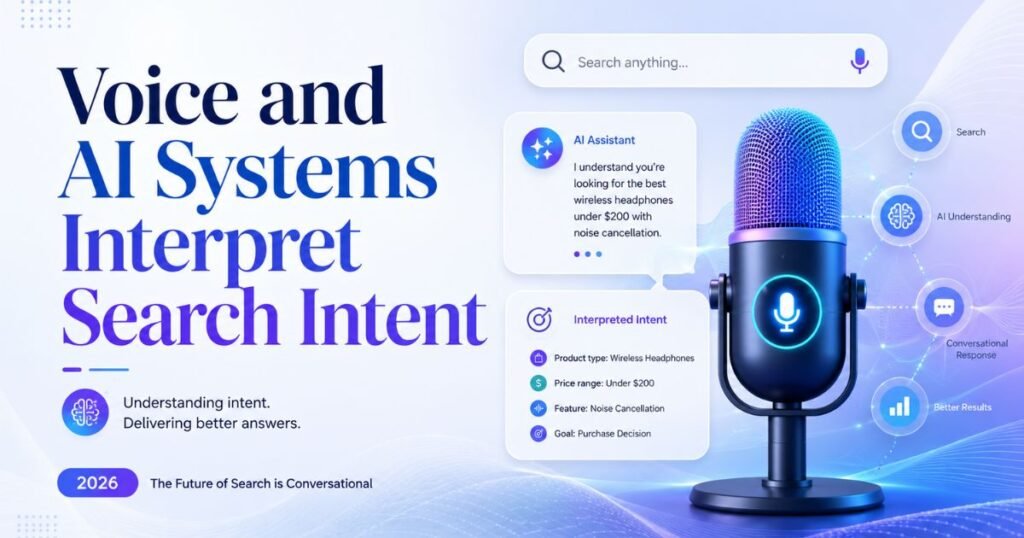
Every useful strategy begins with search intent. A person may want a definition, nearby service, product comparison, appointment, or purchase. Voice and AI systems try to identify that purpose. Pages that satisfy the underlying task usually perform better than pages built around keyword repetition.
Context also matters. “Best running shoes” differs from “best running shoes for flat feet under $120.” The second query contains needs and constraints. Your content context should answer those conditions clearly instead of offering a generic product list.
Question-based voice search queries
Strong question-based voice search queries often start with who, what, where, when, why, or how. They reveal the user’s task directly. Useful question-based keywords may include cost, availability, comparison, safety, location, or timing. Each modifier changes the answer the user expects.
Natural language content optimization
Effective natural language content optimization doesn’t mean writing casually without structure. It means matching how people explain problems. When planning how to optimize for natural language, use plain wording, complete answers, related concepts, and clear examples. Avoid awkward keyword insertions that weaken trust.
The AI-driven buyer journey
An AI-driven buyer journey may begin with education and continue through several comparisons. The user might never visit during early research. Later, they may search the brand directly. This means brand visibility can influence a conversion even when the first AI answer produces no immediate click.
Which Voice Search and AI Platforms to Prioritize
Platform priority should reflect your audience. Google remains central for web, shopping, and local discovery. Microsoft Bing and Copilot provide additional citation opportunities. ChatGPT can send trackable visits when websites permit OAI-SearchBot access. OpenAI confirms that publishers can measure ChatGPT referral traffic through analytics.
Your business model should guide the final choice. A local clinic may prioritize Google and Apple navigation. An ecommerce store may focus on Google shopping surfaces and conversational product research. A B2B company may value ChatGPT, Copilot, and evidence-rich professional content.
| Platform | Main opportunity | Best content focus |
|---|---|---|
| Google Search | Web discovery, AI Overviews, local results, shopping | Helpful pages, products, local details, original evidence |
| Microsoft Copilot | Generated summaries and source citations | Clear facts, comparison content, reliable supporting pages |
| ChatGPT Search | Conversational research and cited referrals | Crawlable pages, strong explanations, authoritative sources |
| Siri | Local, mobile, and action-led requests | Accurate business details, location information, mobile usability |
| Alexa | Household requests and selected commerce tasks | Product clarity, simple actions, consistent business data |
| Google Assistant | Spoken discovery and device actions | Local relevance, direct answers, accessible content |
How to adapt SEO for AI agents
Learning how to adapt SEO for AI agents doesn’t require creating a separate website. Start with your strongest pages. Improve their evidence, structure, entity clarity, and completeness. A practical AI search optimization strategy should strengthen existing SEO instead of chasing unsupported platform tricks.
Future of AI agent voice search
The future of AI agent voice search will likely involve more actions, personalization, and multimodal input. Users may combine speech, images, maps, and prior context. However, the safest approach remains stable: publish accurate information and keep every important action easy to complete.
How to Research Conversational Queries and Spoken Intent
Traditional keyword research tools still provide valuable demand signals. However, they rarely capture every spoken variation. Combine data from Google Keyword Planner, Semrush, and Ahrefs with sales calls, support tickets, site searches, reviews, and customer interviews.
This wider method reveals conversational keywords that real people use. It also exposes objections and follow-up questions. When learning how to find voice search keywords, focus on the complete problem rather than collecting hundreds of slight phrase variations.
Long-tail keywords for voice search
Useful long-tail keywords include meaningful details. The phrase long-tail keywords for voice search might combine service, location, budget, urgency, and audience. For example, “Which emergency plumber near Austin works after midnight?” reveals more intent than “Austin plumber.”
Conversational keywords for voice search
The best conversational keywords for voice search sound like natural questions. Study how customers describe their needs without industry jargon. The best keywords for voice search optimization usually reflect authentic language and a clear task. They aren’t simply the longest phrases available.
Practical voice search optimization approach
A practical voice search optimization approach maps each question to the most suitable page. Don’t force one article to answer every need. Your voice search content strategy should connect guides, comparisons, service pages, product pages, and local pages through relevant internal links.
| Research source | What it reveals | How to use it |
|---|---|---|
| Search Console | Existing queries and landing pages | Find questions already producing impressions |
| Customer calls | Natural wording and objections | Create answers using real customer language |
| Reviews | Benefits, problems, and location terms | Improve service pages and FAQs |
| Internal search | Information visitors can’t find | Repair navigation and content gaps |
| Keyword platforms | Search demand and related terms | Validate topics and compare opportunity |
| AI answer testing | Cited sources and response patterns | Identify missing evidence or unclear explanations |
How to Create Content for Voice Search and AI Answers
Strong voice-friendly content answers a specific question early. Then it adds context, evidence, limitations, and examples. This helps readers scan quickly without sacrificing depth. It also supports systems seeking accurate passages for direct answers or generated summaries.
Google recommends original and useful work rather than mass-produced pages with little added value. Automatically publishing many generic articles can violate scaled-content policies. A durable strategy adds experience, analysis, data, or practical detail competitors cannot easily copy.
How to optimize content for AI agents
When planning how to optimize content for AI agents, make every important claim easy to verify. Name the source, date, method, and limitation. Better evidence improves content discoverability because systems can connect your claims with established facts and relevant entities.
How to write concise answers for voice search
Learning how to write concise answers for voice search requires discipline. Give the direct answer first. Then explain it. This approach also supports how to structure content for direct answers because each section contains one clear purpose and enough context to remain accurate.
How to optimize for featured snippets
For how to optimize for featured snippets, use descriptive headings and compact explanations. Match the format to the request. A definition needs a paragraph. A comparison may need a table. Understanding why featured snippets matter for voice search helps, but snippets don’t guarantee spoken selection.
How AI agents use featured snippets
The phrase how AI agents use featured snippets can be misleading when treated as a fixed rule. Assistants may draw from different sources and systems. Still, well-structured featured snippets demonstrate a useful principle: clear answers near relevant questions make information easier to retrieve.
Illustrative content case
Imagine a Denver HVAC company targeting “Why is my furnace making a clicking sound?” A weak page repeats the phrase. A stronger page explains likely causes, safety limits, repair costs, and emergency signs. That depth improves usefulness while creating several citation-ready answers.
Technical SEO and Structured Data for Voice and AI
Technical accessibility supports every other improvement. Search systems cannot use content reliably when scripts hide it, links don’t reach it, or robots rules block it. Good mobile-first SEO also matters because many spoken searches begin on phones or connected devices.
Google says no special schema markup is required for generative AI visibility. However, valid structured data can help Google understand products, organizations, articles, and local businesses. Markup must match visible page content and follow feature guidelines.
Structured data for voice search optimization
Using structured data for voice search optimization should support meaning rather than manipulate rankings. Apply the most relevant type and maintain accurate fields. Understanding how schema markup helps voice search means recognizing its limits. Markup clarifies information, but it cannot rescue thin or inaccurate content.
Mobile-first optimization for voice search
Effective mobile-first optimization for voice search combines responsive design, readable text, stable layouts, and simple actions. When studying responsive design for mobile voice search, test real phones. Ensure users can call, book, buy, or navigate without zooming or fighting small controls.
How page speed affects voice search
The link between how page speed affects voice search and performance is practical. Slow pages interrupt urgent journeys. Improve page loading speed by compressing images, reducing unnecessary scripts, and using efficient delivery. Core Web Vitals assess loading, responsiveness, and visual stability.
How to make a website voice-search friendly
For how to make a website voice-search friendly, begin with crawlable HTML, clear headings, descriptive links, and accessible navigation. Then improve the mobile user experience. This approach also answers how to improve mobile user experience without relying on special voice-only pages.
How to Optimize Local Search and Voice Commerce
Local discovery often carries immediate intent. A customer may ask for a nearby dentist open on Saturday or a restaurant serving gluten-free meals. Strong local SEO connects accurate business information with these location-based searches.
Google says local results mainly depend on relevance, distance, and prominence. Businesses should keep their Google Business Profile complete and accurate. Authentic customer reviews can also support prominence and help customers judge suitability.
How to optimize local SEO for voice search
Learning how to optimize local SEO for voice search begins with complete information. Publish accurate hours, services, phone numbers, accessibility details, and service areas. Effective local voice search optimization answers practical questions that users ask before visiting or calling.
Near me voice search queries
For near me voice search queries, don’t stuff “near me” into every paragraph. Search systems already consider location. Instead, build genuine local relevance through useful pages, consistent addresses, service details, and natural local keywords connected to real neighborhoods or cities.
How to optimize Google Business Profile
The process for how to optimize Google Business Profile includes correct categories, current hours, useful photos, and accurate services. Keep information consistent across your website and trusted directories. Google’s local guidance emphasizes complete details because they help match businesses with relevant searches.
Customer reviews for local voice search
Authentic customer reviews for local voice search can reveal what customers value. They may mention speed, location, service quality, or accessibility. Never manufacture reviews. Instead, request honest feedback and respond professionally. This approach strengthens trust and provides useful decision context.
Voice commerce
Voice commerce works best when product data answers practical questions. Include price, stock, delivery, returns, compatibility, and variants. Google supports Product and Offer markup for richer product understanding, although rich presentation is never guaranteed.
How to Build Brand Authority and Earn AI Citations
Earning AI citations starts with publishing something worth referencing. Generic summaries offer little distinction. Original research, expert testing, transparent methods, and accurate definitions create stronger reasons for AI systems and human publishers to cite your work.
Authority also depends on consistency. Keep names, services, locations, leadership, and policies aligned across your site. Google’s Organization markup guidance notes that structured information can help disambiguate an organization and clarify administrative details.
How to get cited in AI-generated answers
For how to get cited in AI-generated answers, support claims with primary evidence. Explain who produced the information and when. Strong sourcing improves brand visibility in generative search because systems can assess your content within a broader network of trusted information.
How to improve visibility in AI search engines
Learning how to improve visibility in AI search engines involves more than keyword placement. Publish unique evidence and earn relevant mentions. Maintain accurate entity information. These GEO optimization techniques support understanding and trust without pretending that citations can be guaranteed.
How to appear in AI Overviews
When considering how to appear in AI Overviews, follow Google’s normal SEO guidance. There is no special AI schema or secret file. Your pages must be indexable and useful. Google also advises against inauthentic mention schemes designed only to manipulate AI visibility.
How to optimize for generative AI search
A strong answer to how to optimize for generative AI search combines original value, clear explanations, accessible pages, and credible sources. Don’t confuse visibility with control. Answer engines choose sources dynamically, and results may change across users, prompts, locations, and dates.
How to Measure, Audit, and Improve Voice and AI Visibility
Measurement must extend beyond search rankings. Track impressions, citations, visits, branded searches, calls, bookings, and assisted conversions. Some users may discover your brand through an AI response and return later through another channel. That journey requires broader attribution.
In June 2026, Google introduced dedicated generative AI reporting in Search Console. Bing’s AI Performance report shows cited pages and grounding queries. OpenAI allows publishers to track ChatGPT referrals when OAI-SearchBot can access their content.
How to monitor voice search performance
There is no universal report for how to monitor voice search performance. Use search performance monitoring to examine conversational queries, local actions, mobile visits, and landing pages. Combine platform data with call tracking, form submissions, and customer feedback.
How to track AI search visibility
For how to track AI search visibility, record when your brand appears, whether it receives citations, and which pages support those mentions. Consistent AI visibility tracking is more useful than occasional manual checking because generated responses can change over time.
How to measure voice search traffic
The challenge with how to measure voice search traffic is attribution. Analytics rarely label every voice visit directly. Use query patterns, mobile behavior, local actions, and landing-page trends as indicators. Avoid claiming precision that your data cannot support.
Tools for tracking AI brand visibility
Useful tools for tracking AI brand visibility include official dashboards first. Google Search Console, Bing Webmaster Tools, and web analytics provide grounded data. Third-party platforms may assist, but validate their methods before treating visibility scores as business outcomes.
| Measurement area | Useful evidence | Main limitation |
|---|---|---|
| Google AI visibility | Generative AI impressions, clicks, pages, queries | Visibility doesn’t always reveal the full answer context |
| Bing and Copilot | Cited pages and grounding queries | Citation volume doesn’t equal conversion value |
| ChatGPT | Tagged referral visits | Mentions without clicks remain harder to measure |
| Local voice activity | Calls, directions, bookings, profile actions | Not every action can be tied directly to voice |
| Brand demand | Branded searches and direct visits | Several marketing channels may influence growth |
| Conversion quality | Leads, revenue, appointments, repeat visits | Attribution may span multiple sessions |
Using user feedback
Direct user feedback can expose gaps that analytics miss. Ask customers how they found the business and what information influenced them. This qualitative evidence helps explain why a page receives visits but fails to build trust or drive action.
Final Thoughts
Knowing how to optimize for voice search and AI answer engines together in 2026 means building one coherent search system. Start with customer questions. Publish reliable answers. Strengthen technical access, local information, and authority. Then measure visibility across traditional search, AI answers, and conversions.
The best voice search ranking factors aren’t isolated tricks. They reflect useful content, clear intent, reliable evidence, and excellent usability. When you apply how to optimize for voice search alongside AI discovery principles, your website becomes easier for both people and machines to understand.
Ultimately, how to optimize for voice search and AI answer engines together in 2026 comes down to clarity and credibility. Don’t chase every new acronym. Create better information than competitors, prove your claims, and make every next step effortless.